
Green Cloud Computing: Reducing the Carbon Footprint of Data Centers
- Minakshi DEBNATH

- 1 day ago
- 5 min read
MINAKSHI DEBNATH | DATE: JUNE 24, 2026

The global shift toward digital-first economies has turned data centers into the critical infrastructure of our time. Yet, this digital expansion carries a steep environmental price. Global data center energy consumption now accounts for roughly 2.5% of worldwide CO₂ emissions a startling figure that actually surpasses the entire aviation industry's total output. For Chief Information Officers and Chief Technology Officers, the concept of green cloud computing has officially migrated from a soft public relations goal into a rigid, board-level operational requirement.
At IronQlad, working alongside our specialized technology integration divisions like QBA and AQcomply, we are counseling enterprise executives that sustainability cannot be achieved through simple offsets. Modern hyperscale infrastructure is hitting harsh thermodynamic walls and tighter regulatory parameters. Achieving true efficiency requires a comprehensive architectural overhaul. We must rethink everything from local chip selection and dynamic software deployment to liquid cooling systems and circular resource management.
The Core Thermodynamic Challenge and the "Carbon Trade-Off"
To meaningfully address your enterprise data center carbon footprint, we have to look past simple utility bills. Environmental impact falls into three distinct categories: Scope 1 covers on-site direct emissions like emergency diesel generators. Scope 2 accounts for indirect emissions from your purchased electricity. Scope 3 represents the trickiest variable the embedded or "embodied" carbon locked inside the hardware itself during extraction, manufacturing, and shipping.
Here is where standard procurement often stumbles: research highlights that 60% to 80% of an IT asset’s total lifetime carbon footprint occurs before the device is ever unboxed. According to a hardware life cycle analysis presented by the International Telecommunication Union, the pre-use phase represents 70% to 90% of a component's embodied carbon.
This creates a hidden "carbon trade-off." For instance, a high-density Solid State Drive (SSD) is far more efficient operationally than a legacy Hard Disk Drive (HDD). Yet, manufacturing that SSD is so carbon-heavy that its embodied footprint can exceed an HDD's manufacturing penalty by over 100 times. If your team installs premium SSD arrays for long-term data archiving where access is rare, you are actually inflating your net carbon output.
Moving Beyond PUE: The Modern Sustainability Metric Matrix
For over a decade, Power Usage Effectiveness (PUE) has been the gold standard for facility efficiency. It measures the simple ratio of total facility energy usage to direct IT equipment load, chasing an ideal score of 1.0. But PUE has a massive blind spot: it treats coal-fired electricity exactly the same as solar energy. Furthermore, a facility can artificially lower its PUE by utilizing massive evaporative cooling loops, slashing its power draw while draining millions of gallons of local fresh water.
To prevent this kind of operational greenwashing, modern cloud architectures rely on a broader family of metrics, often referred to as "xUE."
Metric | Full Name | Ideal Target | Operational Limitation |
PUE | Power Usage Effectiveness | 1.0 | Completely ignores the primary energy source and water stress. |
WUE | Water Usage Effectiveness | 0.0 | Fails to differentiate between greywater and pristine fresh water. |
CUE | Carbon Usage Effectiveness | 0.0 | Strictly tracking operational carbon; completely blind to Scope 3 lifecycle impact. |
As detailed in a technical report by The Green Grid on data center sustainability benchmarks, Water Usage Effectiveness (WUE) quantifies the precise liters of water consumed per kilowatt-hour of IT energy. Simultaneously, Carbon Usage Effectiveness (CUE) directly links facility consumption to the actual carbon intensity of the local grid.
To bridge the gap, enterprise practitioners are adopting Total-Power Usage Effectiveness (TUE). TUE measures both the building's infrastructure overhead and the computational efficiency of the silicon itself. After all, a data center with a stellar 1.1 PUE running obsolete, power-hungry servers will still produce a higher net carbon footprint than a 1.3 PUE facility running the latest energy-efficient architecture.
Silicon and Software: Driving Code-Level Efficiency

The most direct way to scale green cloud computing is to execute more transactions per watt. Traditional x86 chips are increasingly stepping aside for ARM architectures and customized Application-Specific Integrated Circuits (ASICs). Custom chips like AWS Graviton3 or Google Tau routinely deliver 40% to 60% lower power consumption for identical processing outputs.
At the silicon level, teams are utilizing Dynamic Voltage and Frequency Scaling (DVFS). This mechanism actively lowers chip voltage and operating frequencies during periods of low computational demand. According to research published on energy-efficient virtualization by the CLOUDS Lab at the University of Melbourne, implementing DVFS-aware consolidation logic can slash active data center energy expenditure by up to 41.6% without degrading user service quality.
Software deployment models change the equation too. While traditional virtual machines optimized hardware use decades ago, containerization takes it a step further. Comparative software environment metrics published in Frontiers in Big Data indicate that shifting workloads from traditional virtual machines to Docker containers drops energy consumption and net CO₂ emissions by an average of 21.6%, since containers bypass guest operating system overhead by sharing the host's direct kernel.
The Frontier of Thermal Management and Energy Procurement
As generative AI pushes rack densities past 120 kW, air cooling is proving entirely inadequate. Air simply lacks the thermal capacity to move that much heat without spinning thousands of high-wattage fans.
This reality is forcing a major migration toward single-phase and two-phase liquid immersion cooling, where servers are submerged in non-conductive dielectric fluids. Transitioning a 10 MW facility to immersion cooling saves between 18 and 45 million gallons of water annually. While fluid costs represent up to 25% of initial equipment CAPEX, the operational power savings routinely yield a full financial payback within 1.6 to 2.5 years.
On the energy procurement side, leading data centers are moving past old-school Renewable Energy Credits (RECs), which only balance energy use on an annual average. Instead, companies are pivoting toward 24/7 Carbon-Free Energy (CFE). As championed by the Global Renewables Alliance's CFE implementation framework, this approach matches a data center’s hourly consumption with local, real-time green generation.
The Efficiency Paradox: Facing the Jevons Effect
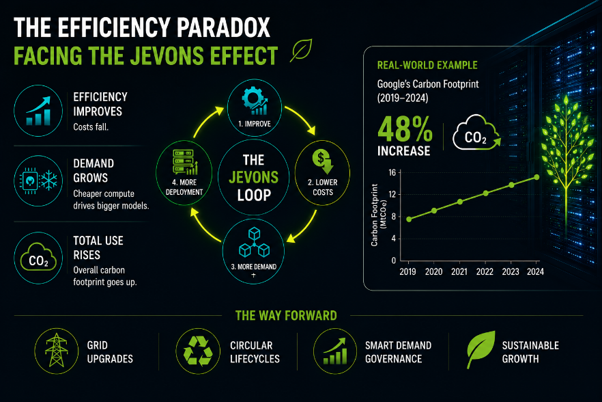
As tech leaders implement these breakthroughs, we must confront a classic economic trap: the Jevons Paradox. This principle states that as technological progress increases the efficiency with which a resource is consumed, the total consumption of that resource actually goes up because dropping unit costs fuel exponential demand.
We are seeing this play out clearly across the AI space. Every time a chipmaker introduces a more efficient GPU or a cooling provider reduces operational costs, running complex models becomes significantly cheaper. This cost drop triggers the deployment of even massive architectures and heavier workloads.
Look at the hyperscale market as a prime example: despite pioneering some of the most advanced cooling and chip architectures in history, Google's overall carbon footprint surged 48% over a five-year period, driven directly by the frantic expansion of its AI data center infrastructure. Efficiency alone cannot solve the problem; it must be coupled with structural grid upgrades and smart circular resource lifecycles.
Building a Regenerative Core
True sustainability in the cloud era will be measured by our ability to transform data centers from isolated energy sinks into integrated, regenerative nodes within our local communities. This includes launching specialized "Circular Centers" to harvest silicon components from older servers, deploying zero-emission proton-exchange membrane hydrogen fuel cells for emergency backup power, and piping liquid-cooling waste heat directly into local municipal district heating networks to warm nearby homes.
The roadmap for your organization requires a unified approach. By aligning hardware lifecycle awareness, deep learning optimization tools, and strict 24/7 energy matching, we can ensure your digital transformation rests on a highly resilient, green foundation. Explore how IronQlad and our specialized infrastructure teams at AmeriSOURCE can help audit and insulate your modern cloud environment today.
KEY TAKEAWAYS
Data center footprints account for roughly 2.5% of global carbon emissions, making green cloud architecture a top-tier corporate boardroom priority.
Embedded carbon represents up to 90% of hardware's manufacturing footprint, requiring precise lifecycle planning to balance operational efficiency against production penalties.
Traditional PUE metrics are giving way to holistic indicators like CUE and TUE to track actual grid carbon intensity and silicon efficiency.
Liquid immersion cooling and chip-level DVFS frameworks can reduce raw cooling energy demands while providing financial payback within two years.
The Jevons Paradox shows that technological efficiency gains drop operational costs, which inadvertently spikes total long-term compute demands.


Comments