
The Role of Cybersecurity in Electric Vehicle Charging Networks
- Minakshi DEBNATH

- 2 hours ago
- 7 min read
MINAKSHI DEBNATH | DATE: JUNE 22, 2026
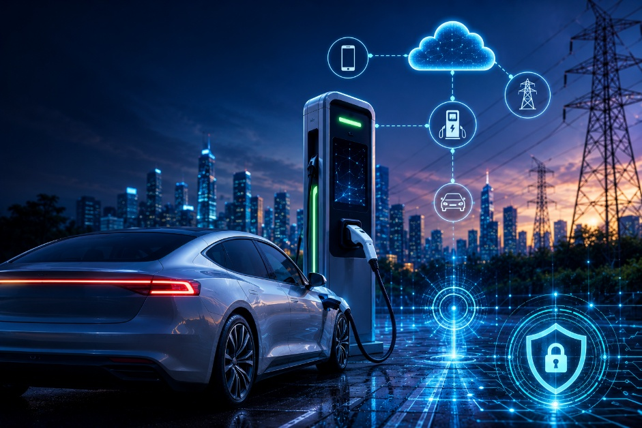
Every time an electric vehicle hooks up to a public plug, it connects a massive rolling battery to a complex digital ecosystem and the high-voltage electrical grid. This isn't just a simple power connection; it is a sophisticated endpoint in an intricate web of Cyber-Physical Power Systems (CPPS). As the world rushes to build out charging terminals, we are quietly expanding a highly integrated and poorly defended digital attack surface. For enterprise IT leaders, a breach across this network is no longer a localized operational headache it is a critical national security and boardroom threat capable of triggering large-scale grid blackouts, widespread financial fraud, and catastrophic corporate data leaks.
At IronQlad, alongside our specialized enterprise security network partners like AmeriSOURCE and AQcomply, we are counseling CIOs and technology directors to look beyond the physical concrete and copper. EV charging cybersecurity is fundamentally a software and systems integration challenge. If your organization treats charging deployment as a standard facilities project rather than an enterprise-grade IT implementation, you are leaving the keys in the ignition for advanced threat actors.
Moving Beyond the "Dumb Plug" Architecture
To defend this rapidly expanding footprint, engineering teams have to shift their perspective. The modern Electric Vehicle Supply Equipment (EVSE) unit isn't just a static electrical distribution hub. Instead, these systems operate as intelligent edge devices running complex internal software stacks, embedded payment processors, and dynamic telemetry modules.
This entire environment functions as a multi-layered, interconnected system of systems. The physical charger sits at the center of a constant conversation on one side, it's exchanging low-level data with the vehicle; on the other, it's talking upstream to a cloud-based Charging Station Management System (CSMS). In high-power scenarios like the Extreme Fast Charging (XFC) corridors now appearing along major highways around the world that conversation grows far more complex, pulling in third-party cloud operators, driver mobile apps, and direct smart grid utility connections all at once. Because these elements are tightly coupled, an identical vulnerability found anywhere in the chain can completely compromise downstream physical equipment.
Protocol Gaps: The Fractured Realities of OCPP and ISO 15118
The underlying glue holding this cross-vendor ecosystem together is standardization. However, standardizing software interfaces before securing them introduces widespread systemic vulnerabilities.
Consider the Open Charge Point Protocol (OCPP), the primary language governing data exchange between the physical charger and the cloud-based backend CSMS. Early variations, particularly OCPP 1.6, became the industry's de facto deployment standard but lacked native, mandatory security enforcement. According to an eInfochips architecture deep dive, version 1.6 did support Transport Layer Security (TLS) but left it entirely up to implementers whether to actually use it. That optional stance has had real consequences: hundreds of thousands of chargers in active operation today still communicate over plain text, leaving them open to Man-in-the-Middle (MitM) attacks where malicious actors can intercept and manipulate JSON messages to tamper with billing accounts or siphon off unlimited free energy.
The newer OCPP 2.0.1 standard attempts to reverse this trend by establishing a "secure by design" posture, introducing mandatory TLS 1.2/1.3 configurations and rigid certificate distribution profiles. Yet, here is the problem: as the Open Charge Alliance notes in its official protocol guidelines, OCPP 2.0.1 is not backward compatible with legacy 1.6 frameworks. This reality leaves operators managing a deeply fragmented operational footprint where unpatched legacy hardware remains actively exposed to automated exploits.
The risk extends directly to the driver's interface via ISO 15118, which facilitates premium features like "Plug & Charge." This protocol lets drivers plug their vehicles directly into a station and complete payments automatically using digital contract certificates stored inside the car. While it optimizes the user experience, it depends on an intricate Public Key Infrastructure (PKI) populated by multiple certificate authorities and third-party vendors.
A troubling vector exposed in an arXiv research study titled 'A Relay Attack on ISO 15118' showed that the digital signatures used for payment authorization do not tie themselves to station-specific coordinates. Security researchers successfully staged an application-layer relay attack where a fake charging terminal emulated a legitimate endpoint, intercepted a victim vehicle's contract token, and relayed that cryptographic handshake to an automated station miles away where an attacker’s car was parked. The real network accepted the credential, leaving the victim to pick up the tab. What does this mean for enterprise fleet operators? It means your network's integrity is strictly defined by its absolute least-secure endpoint.
Physical Exploits, Application Bugs, and the CAN Bus Pivot

The threat vectors for charging infrastructure security aren't isolated to cloud-hosted code. Because public chargers sit in remote, unsupervised parking lots, they are constantly exposed to physical tampering. Attackers can pry open terminal housings to access hardware maintenance pins like JTAG, USB, or UART interfaces. Through these internal links, a hacker can easily download administrative passwords, steal embedded cryptographic keys, or flash a compromised firmware image directly to the unit. According to a Sandia National Laboratories cybersecurity benchmark paper, even simple physical indicators can be exploited; researchers managed to force certain chargers into insecure factory default settings simply by flashing a precise light sequence at an unshielded photodiode.
But for automotive engineers, the ultimate nightmare scenario is a pivot attack: using a compromised physical charger as a gateway to crack the connected vehicle's core operating network.
Vehicles utilize an internal Controller Area Network (CAN) bus to control mission-critical functions like braking, electronic steering, and powertrain distribution. According to a technical analysis by VicOne regarding CAN injection exploits, the CAN bus protocol was architected decades ago without native data encryption or endpoint authentication. By gaining physical entry via an unmapped charging interface, attackers can execute injection exploits, flooding the car's ECUs with high-priority overriding messages (such as ID 0x00). In controlled testing environments, these attacks have successfully overridden steering commands and disabled physical brakes, turning a software exploit into an immediate life-safety crisis.
Weaponizing the Grid: Coordinated Load Attacks
The true scale of this problem comes into view when we see how individual charging points can be combined into a weapon against localized power grids.
Under the Manipulation of Demand via EV IoT (MaDEVIoT) vector, attackers can compromise cloud-based management consoles to build an active botnet composed of thousands of high-power connected chargers. By commanding these units to repeatedly cycle on and off in unison, hackers can induce massive frequency instabilities and voltage spikes across distribution substations. According to a system simulation published by arXiv, a coordinated breach targeting a single dominant fleet provider in the Manhattan grid could easily trigger automatic over-frequency protection relays by 2030, precipitating a catastrophic regional blackout.
Fortunately, we can use the exact same architecture to protect our energy distribution networks. By deploying bidirectional Vehicle-to-Grid (V2G) power interfaces, we can convert plugged-in electric vehicles into a distributed defense shield. As explored in an arXiv paper exploring robust mitigation schemes, modern V2G-enabled terminals can shift between charging mode and emergency discharge mode within 1 millisecond. This ultra-fast response acts as an immediate wide-area power dampener, neutralizing malicious switching frequency spikes before they cascade through the local power utility.
Defending Infrastructure with Machine Learning
At IronQlad, our enterprise technology division is collaborating with AI specialists at QBA and AJA Labs to move past traditional, signature-based network firewalls. Because the volume and speed of modern data transactions are so immense, your enterprise needs proactive, automated anomaly detection.

Our active implementations rely on Deep Learning frameworks, specifically Long Short-Term Memory (LSTM) Autoencoders. These models process multivariate time-series data streams to map out a clear baseline of normal network behavior. If a packet payload or a data signature shifts indicating a zero-day exploit attempt the system catches the discrepancy instantly. According to an AI-driven attack detection study published by MDPI, LSTM Autoencoders achieve a 97.1% accuracy rating and a 98.6% recall metric when mapping packet-level traffic across EVSE networks.
Additionally, we are pioneering Federated Learning architectures across cloud operators. This enables regional networks to train robust threat detection algorithms collectively without ever exchanging sensitive customer billing records or protected PII, striking a balance between corporate privacy and collective defense.
Global Regulatory Compliance and the Path Forward
Ignoring these vulnerabilities is no longer an option for corporate leaders. Global oversight bodies are codifying these security practices into mandatory compliance checklists.
In the United States, the National Electric Vehicle Infrastructure (NEVI) formula program requires state-funded charging stations to document comprehensive cybersecurity playbooks. According to an executive brief from VicOne on the NIST IR 8473 framework profile, networks must tie their systems to the core pillars of security: Identify, Protect, Detect, Respond, and Recover. Meanwhile, the European Union's Alternative Fuels Infrastructure Regulation (AFIR) requires digital networking for all public infrastructure, pushing for mandatory adoption of OCPP 2.0.1 and ISO 15118-20 by 2027 alongside compliance with the Radio Equipment Directive (RED).
Building a secure future for sustainable mobility requires a holistic, system-wide approach. Hardware vendors must eliminate embedded credentials and deploy hardware roots of trust on the factory floor, while network operators must implement continuous AI-driven anomaly tracking across all endpoints. By aligning strict software hygiene, predictive deep learning, and robust global compliance, we can ensure that our green transition rests on an unshakeable digital foundation. Explore how IronQlad and our expert sub-divisions like AmeriSOURCE and AQcomply can accelerate and insulate your enterprise transformation journey.
KEY TAKEAWAYS
Modern charging networks are highly interconnected cyber-physical systems, transforming standalone electrical plugs into complex, software-driven edge networks exposed to serious digital vulnerabilities.
Legacy software protocols, such as unencrypted OCPP 1.6 frameworks, leave infrastructure highly exposed to unauthenticated Man-in-the-Middle billing exploitation and remote code execution.
Physical access to unmonitored charging kiosks provides entry points for JTAG/UART firmware modification and severe automotive CAN bus injection pivots that compromise vehicle steering and braking.
Large-scale botnet exploits, such as MaDEVIoT attacks, can orchestrate thousands of compromised chargers to trigger artificial load oscillations, threatening regional utility grid collapse.
Enterprise-grade protection requires the integration of deep learning models like LSTM Autoencoders and compliance with emerging frameworks like NIST IR 8473 and Europe's AFIR mandates.



Comments