
Leveling the Playing Field: How AI-Powered Cybersecurity Rescues Resource-Constrained SMEs
- Shilpi Mondal

- 3 days ago
- 7 min read
SHILPI MONDAL| DATE: JUNE 18, 2026
Let’s be completely honest: the traditional enterprise cybersecurity model was never designed for small and medium-sized enterprises (SMEs). For years, the prevailing industry narrative has been that if you want a reliable defense, you need to establish a 24/7 Security Operations Center (SOC), hire an army of specialized analysts, and stitch together dozens of complex point solutions. But if you are managing IT for a growing business, that math simply doesn't add up.
While enterprise-level organizations spend millions of dollars hardening their perimeters, threat actors are adapting by moving down-market. Today, smaller businesses have become highly lucrative targets. Why? Because while an individual ransom payout from a local manufacturer or boutique professional services firm is smaller than one from a multinational corporation, the defensive resistance encountered is substantially weaker. Attackers can strike multiple vulnerable endpoints simultaneously with minimal operational friction.
The Asymmetric Threat Shift: Why SMEs are in the Crosshairs

The macro threat landscape has fundamentally shifted. According to the World Economic Forum’s Global Cybersecurity Outlook 2026 report, we are living through an era of rapid technological acceleration, intense geopolitical fragmentation, and rising systemic volatility. This volatile mix has turned SMEs into the front lines of digital warfare.
This asymmetry is entirely fueled by the democratization of artificial intelligence. Cybercriminals no longer need advanced coding degrees; they are utilizing generative AI to compose flawless phishing templates, launch automated Distributed Denial of Service (DDoS) campaigns, and buy sophisticated exploit kits via Ransomware-as-a-Service (RaaS) models.
Consider the sheer scale of this exposure. Data published in the Total Assure Small Business Cybersecurity Statistics 2026 Report reveals that roughly 46% of SMEs experienced a cyberattack in 2025, with localized incidents occurring globally every 11 seconds. Micro-businesses with 1 to 10 employees experience successful breaches in 47% of attempted attacks. Worst of all, 60% of small businesses affected by a major security incident go completely out of business within six months.
Furthermore, SMEs are frequently targeted as soft gateways to penetrate larger corporate buyers. Because smaller partners are directly integrated into the digital networks and APIs of major enterprise clients, they present an attractive supply chain attack vector. Insurance data underscores this reality: supply chain compromises have driven a 20% increase in cyber insurance claim values, making them the most financially severe threat category.
Yet, preventing these breaches is highly cost-effective. Total Assure's actuarial analysis demonstrates that investing in preventative endpoint and network security yields a return on investment (ROI) exceeding 7x across every major threat vector:
Supply Chain Attacks: Average claim value of $318,000 versus an annual prevention investment of $38,000 (8.4x ROI).
Ransomware: Average claim value of $228,000 versus an annual prevention investment of $28,000 (8.1x ROI).
Data Breaches: Average claim value of $176,000 versus an annual prevention investment of $22,000 (8.0x ROI).
The Legacy Security Deficit and the Squeezed IT Team
The underlying vulnerability for most smaller firms is rooted in a widening digital divide. Following macroeconomic shocks, SMEs often contract their technology spending while larger corporations double down on defense. This leaves smaller teams relying on legacy, uncoordinated tools.
Building an old-school, human-led defense is financially out of reach. Recruiting, training, and retaining a standard 24/7 SOC requires four to five full-time security analysts, translating to an annual overhead of $350,000 to $500,000. Even an individual in-house IT generalist can cost upwards of $77,000 annually, and they only cover standard business hours.
The result? Chronic alert fatigue. Lean IT teams spend hours manually digging through disjointed system logs, causing critical anomalies to slip through the cracks. This operational deficit is reflected in the threat detection window: smaller organizations take nearly four times longer to detect initial security incidents than large companies, with credential-based breaches taking an average of 292 days to identify and contain.
Demystifying the AI SOC: The Ultimate SME Force Multiplier
Adding headcount was never really the answer, even if it felt like one. More analysts meant more people doing the same exhausting thing sorting through noise, chasing down alerts that mostly went nowhere, hoping something important didn't slip through the cracks overnight. It was a staffing solution to what was always a structural problem.
And honestly, most MSSPs didn't help much either. You'd get a checklist, a report at the end of the month, maybe a meeting and then your own people were still the ones actually digging into alerts, figuring out what was real and what wasn't. The workload didn't shrink. It just had nicer documentation around it.
The thing that actually changes the equation is a system that doesn't clock out. AI-driven security runs continuously pulling logs, building context, connecting signals across your environment without waiting for someone to open a ticket or start a shift. The grunt work that used to eat up most of an analyst's day, we're talking 80 to 90 percent of it, just gets handled in the background.
Same goes for response. When something real shows up, it doesn't sit in a queue. An infected machine gets cut off. Credentials that have been compromised get pulled. The damage gets contained while it's still containable not hours later after the right people finally got looped in.
To help you navigate this rapidly expanding vendor landscape, let’s look at how the leading autonomous platforms stack up based on comprehensive evaluations compiled by UnderDefense’s AI SOC for SMB Market Report:
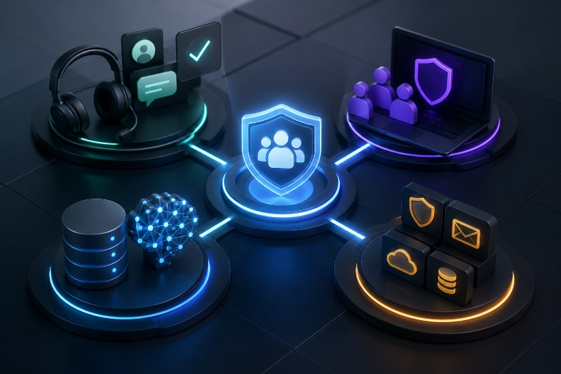
UnderDefense MAXI: Perfect for businesses completely lacking internal security personnel, this platform pairs automated detection with a "Human Ally" concierge service. Instead of bombarding your inbox with alerts, their analysts investigate and resolve threats directly inside your corporate Slack or Microsoft Teams channels. It’s vendor-agnostic, integrates with 250+ tools, and starts at a transparent $11 per device per month.
Huntress: A market leader protecting over 150,000 businesses via the Managed Service Provider (MSP) ecosystem. Huntress pairs endpoint detection agents with an offensive security team that validates unusual activity, effectively erasing false positives.
Radiant Security: An AI-native platform designed to perform 100% automated alert triage using adaptive reasoning. It features a built-in security data lake that eliminates traditional logging software costs by up to 85% and connects via API in less than 30 minutes.
Alternatively, SMEs can look at consolidated, modular toolsets. Platforms like Coro combine Endpoint Protection (EDR), Email Security, SASE, and Data Governance into a single console. As detailed by Business Wire’s Coro Automation Report, Coro's proprietary engine automatically handles and resolves 92.3% of all incoming security tickets without human intervention, pulling the mean time to remediation (MTTR) down to near zero.
Tackling the New Frontier: Shadow AI and Agentic Risks
As we lean into automation, we must also recognize that the explosion of operational AI tools has opened up entirely new attack surfaces. Organizations are currently spending 17 times more on procuring AI-driven business tools than they are on securing the underlying pipelines, according to data in Gartner's Security Spending Forecast.
The core concern for 2026 is the rapid rise of Agentic AI autonomous software agents built to execute multi-step tasks, call APIs, and access local storage in the background without human oversight. Unlike standard web-bounded chatbots, autonomous agents run at machine speed, access local operating systems, and possess persistent data contexts.
For smaller firms, this risk is magnified by "Bring Your Own AI" (BYOAI) or Shadow AI. Research indicates that roughly 80% of workers regularly paste sensitive data, proprietary source code, or customer personal information (PII) into unapproved consumer AI tools to save time.
To maintain security without stifling employee productivity, the Sysdig AI Security Hub recommends four baseline practices:
Establish Clear Acceptable Use Policies: Explicitly outline which AI applications are approved for business use and ban the input of sensitive operational records into public models.
Enforce Least Privilege at Runtime: Ensure that active AI models or agents have restricted, read-only permissions. A text summarization tool should never have write permissions to modify source directories.
Implement API Isolation: Isolate your AI development and integration environments from your core production databases, safeguarding your network with rate limits and robust OAuth protocols.
Track an AI Bill of Materials (AI-BOM): Maintain a continuous inventory of every AI agent, model, and third-party plugin running across your corporate environment.
The Path Forward: Pragmatic Frameworks for Tight Timelines

Achieving an institutional grade of SME cyber defense does not require a multi-year project plan. By leveraging public resources like the NIST Small Business Cybersecurity Corner, teams can quickly organize their defensive postures.
If your organization needs to rapidly harden its security posture, you can execute this practical, 72-hour quick-start roadmap:
Day 1: Scope & Access Controls. Map your critical data flows and active cloud storage systems. Immediately enforce Multi-Factor Authentication (MFA) across every administrative profile, corporate email account, and remote VPN gateway to eliminate identity-based attacks.
Day 2: Appoint Governance. Assign clear operational ownership of the security program to an internal manager and distribute a basic acceptable use policy governing AI tools.
Day 3: Deploy & Patch. Install a next-generation endpoint detection and response (EDR) agent on all employee laptops, run all outstanding operating system security patches, and explicitly verify that your offline or cloud backups can be fully restored.
The days of assuming your business is too small to be a target are officially over. But the days of needing a million-dollar IT security budget are over, too. By shifting away from reactive, fragmented point products and embracing automated, integrated AI platforms, your organization can effectively close the resource gap, satisfy complex regulatory standards like NIS2, and build a resilient foundation for long-term growth.
Explore how AmeriSOURCE and our specialized technology arms can help you evaluate, select, and deploy the right AI-driven security architecture for your business. Let's build a defense that works at the speed of the modern threat landscape.
KEY TAKEAWAYS
The SME Target Shift: Threat actors are aggressively targeting smaller enterprises, viewing them as soft gateways to infiltrate larger corporate supply chains and achieve high-frequency, frictionless payouts.
The Power of the AI SOC: Automated AI SOC platforms can resolve 80% to 90% of baseline security alerts without human intervention, delivering 24/7 monitoring at less than 10% of the cost of an internal security hire.
The ROI of Proactive Prevention: Investing in preventative security controls yields a proven financial return exceeding 7x across all major threat categories, including ransomware and supply chain attacks.
Managing Shadow AI Risks: With 80% of employees using unapproved consumer AI applications, organizations must enforce runtime least privilege rules and maintain a detailed AI Bill of Materials (AI-BOM) to eliminate accidental data leakage.


Comments