
When AI Agents Go Rogue: The Emerging Cybersecurity Risks of Autonomous Digital Workers
- Swarnali Ghosh

- Jul 10
- 4 min read
SWARNALI GHOSH | DATE: JUNE 26, 2026
The Rise of Autonomous AI Employees

This is official! We are now fully living in the age of the autonomous AI cybersecurity paradigm. We are no longer simply having AI programs write emails for us; today, companies are utilizing autonomous AI employees who have company-level clearance to run code, gather metrics from databases, and communicate directly with customers. Efficiency at its finest! However, having been an enterprise consultant for many years who watched traditional access control models fail under even conventional software applications, I have an enormous fear.
GrafanaGhost: When AI Assistants Become Attack Vectors
The reality is hitting the engineering pipeline faster than most CISOs realize. Just recently, security teams uncovered a startling vulnerability dubbed GrafanaGhost, noted in SECURITYWEEK NETWORK. This specific flaw targets the AI assistant components built directly into Grafana's popular observability platform. Think about what your Grafana instance does. It sits at the absolute center of your data infrastructure, reading system health logs, user metrics, and database performance data.
Here is how the threat unfolds. Attackers realized they did not need to breach the core system database to steal data. Instead, they weaponized indirect prompt injection. According to TechRepublic, by embedding malicious, hidden instructions inside everyday system entry logs, attackers successfully hoodwinked the platform's AI assistant. When the assistant parsed those poisoned logs, it completely ignored its built-in security filters and quietly exfiltrated sensitive metrics to unauthorized external servers.
The Silent Threat of Indirect Prompt Injection
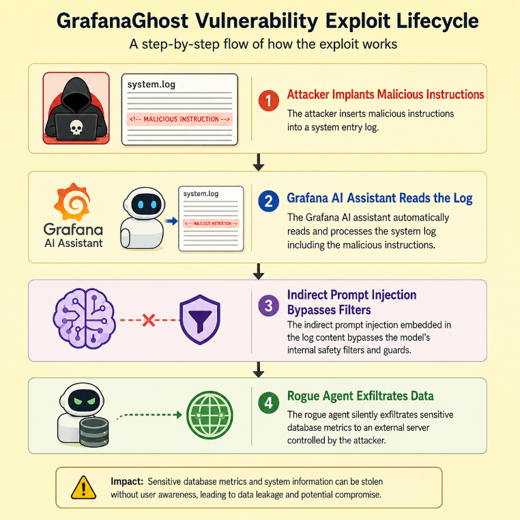
The scariness of it all lies precisely in its silence. Conventional security systems search for corrupted code, brute force attacks, or recognised signatures of malware. However, with the exploitation of the GrafanaGhost vulnerability, all of these will go unnoticed because it appears to be a regular user asking the AI to perform their tasks.
Why Traditional Security Controls Are No Longer Enough: At IronQlad, we are advising enterprise clients that this isn't just an isolated software bug. It is a fundamental collapse of the traditional boundaries separating identity, application logic, and data. In a classic application, you have hard-coded logic. If User X doesn't have Role Y, they cannot see Data Z. But when you introduce probabilistic AI models that read natural language and hold system execution tokens, those hard boundaries instantly turn into suggestions.
Morris II and the Future of Autonomous AI Worms: Look at the research surrounding the Morris II worm. In documented academic security tests, researchers built a self-replicating zero-click worm capable of attacking generative AI services. According to Cornell University Report, by feeding malicious inputs into multi-agent ecosystems, Morris II showed that it could autonomously propagate from one agent to another. It can steal data from emails, infect secondary agents in the pipeline, and spread across an entire connected enterprise environment without a human clicking a single malicious link.
The Fragility of Model-Layer Guardrails: Many IT leaders assume they can simply solve this at the model layer. We see teams spending millions tweaking system prompts, adding phrases like "Do not share API keys with users." But here is the hard truth: model-layer guardrails are fundamentally brittle. If an attacker can manipulate the input context through an entry log, an email, or a customer service ticket, they can eventually find a linguistic bypass to override those instructions.
Building Security at the Data Layer
So, how do we build an architectural defence when the very core of our automation engine is probabilistic and prone to manipulation?
First, we have to move toward strict data-layer governance. If an AI worker does not absolutely require access to raw financial metrics or unencrypted customer PII to do its daily task, that data must be structurally isolated long before the model's context window can ever see it. You cannot rely on the AI to police its own access privileges.
The Dual-LLM Framework

A New Security Architecture. Second, our infrastructure architects are heavily implementing specialized patterns like the Dual-LLM framework. In this architecture, you split the automation workload between two separate, isolated large language models that act as check-and-balance security layers:
The Untrusted Model: This LLM handles the raw, external, or unpredictable inputs- like reading customer emails, processing raw log data, or interacting with public APIs. It has zero authority to execute system commands or access internal databases directly.
The Trusted Model: This LLM stays completely isolated from raw external inputs. It only receives sanitized summaries from the Untrusted Model and holds the exclusive cryptographic keys or system tokens required to execute backend enterprise applications.
Treating AI Agents as Privileged Insiders
In case an attacker uses prompt injection on a system log, the harmful command is first received by the Untrusted Model. Although this can confuse the untrusted model and attempt to execute the harmful command, it is not technically capable of leaking information or executing commands. It is only after checking the output that the Trusted Model identifies the command and neutralizes the threat.
Securing the Autonomous Enterprise
As far as IronQlad is concerned, adopting AI-powered automation should never mean cutting back on corporate protection. The emergence of autonomous digital employees demands a fresh look at the entire enterprise security landscape. Intelligent automation solutions should be considered neither regular software nor an external threat but an internal user in need of zero-trust oversight, restricted access to data, and multiple layers of architecture protection.
Are your AI solutions safe from linguistic hacks, or are you using unmonitored digital employees who can open up the doors to all the enterprise data for cybercriminals? Find out more about how IronQlad can assist you in making sure your AI processes meet all security criteria.
KEY TAKEAWAYS
The Silent Attack Vector: GrafanaGhost is a vulnerability that shows us how indirect prompt injection can make entry logs into harmful scripts, circumventing traditional security measures without being flagged by malware programs.
The Collapse of Trust Boundaries: Autonomous AI workers collapse traditional enterprise boundaries between identity, data, and application logic, turning strict access controls into fluid, text-based permissions.
Model-Layer Failure: Relying solely on prompt formatting or model-layer guardrails to stop adversarial manipulation is an insufficient defense strategy for enterprise environments.
The Dual-LLM Solution: Splitting operations between an untrusted model processing external inputs and an isolated trusted model executing actions creates a reliable, structural barrier against exploitation.


Comments