
Beyond the Port: Navigating the Sophisticated Threat of Juice Jacking in 2026
- Shilpi Mondal

- Feb 5
- 5 min read
SHILPI MONDAL| DATE: JANUARY 30, 2026
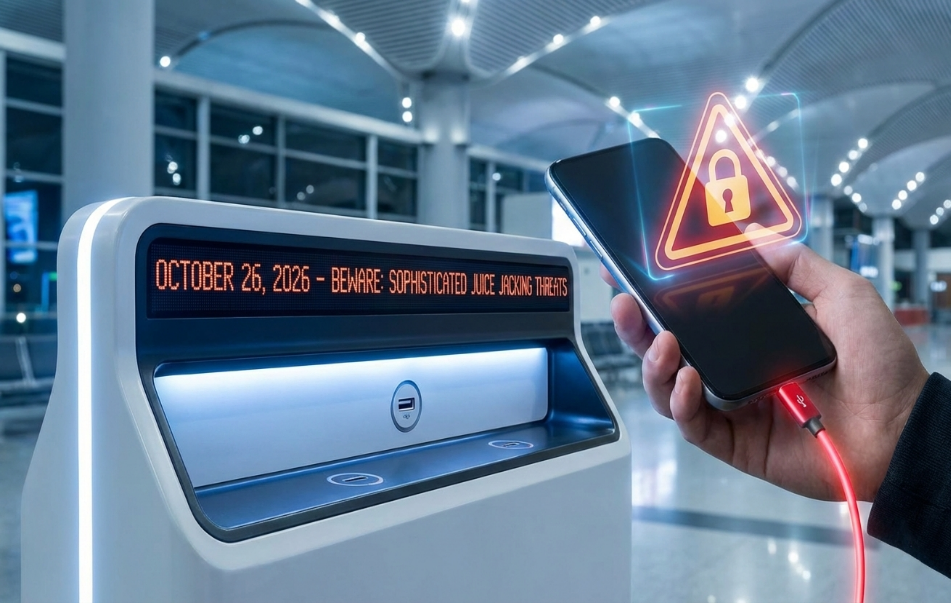
It starts with a low battery notification during a layover and ends with a compromised enterprise network. While the concept of "juice jacking" has been around for over a decade, the 2026 threat landscape has transformed this simple power-drain anxiety into a sophisticated vector for state-sponsored espionage and AI-driven malware.
The Psychology of the "Urgency Trap"
In cybersecurity, we often focus on technical vulnerabilities, yet the most persistent weakness remains human optimism bias. This was clearly demonstrated in 2011 at DEF CON, where attendees-including security professionals-plugged their phones into a suspicious charging kiosk despite visible warnings, as documented by Brian Krebs in “Beware of Juice-Jacking” on Krebs on Security. More than a decade later, this behavior continues. According to the LastPass Blog’s 2025 article, “Juice Jacking in 2025: Want a Side of Malware with That?”, low-battery anxiety still overrides rational judgment, reinforcing the “urgency trap” in which users prioritize immediate charging over security.
What’s changed in 2026 isn't just the frequency of the attacks, but the sheer technical depth of the compromise. We aren't just looking at simple data siphoning anymore. We are looking at protocol-level manipulation that happens faster than a human can blink.
ChoiceJacking: When Your Phone "Decides" Without You

The industry has spent years telling users to watch for the "Trust This Computer" prompt. However, 2026 has introduced us to a family of exploits known as ChoiceJacking. This isn't just a clever name; it’s a race-condition attack that targets the underlying way mobile operating systems handle input events.
As detailed in research from the Graz University of Technology, ChoiceJacking exploits the millisecond-wide window when a device is first connected. The malicious charger floods the device’s input queue with simulated "affirmative" clicks. By the time the security prompt actually renders on your screen, the charger has already "clicked" yes on its own behalf.
Data from early 2026 indicates that high-end devices are particularly susceptible because of their fast internal processing. For example, research presented at the 2025 USENIX Security Symposium found that ChoiceJacking attacks engineered against devices including the Samsung Galaxy S23 can complete in under 300 milliseconds under laboratory conditions - fast enough that a user looking away for a moment would miss any visual prompt entirely.
The USB-C Paradox: Complexity vs. Security
The European Union’s mandate for universal USB-C charging, Directive (EU) 2022/2380, has been a win for sustainability, but it has unintentionally consolidated the attack surface. In the past, attackers needed a variety of proprietary cables. Now, a single malicious USB-C port can target nearly every smartphone, tablet, and as of April 2026-laptop in a traveler's bag.

The USB Power Delivery (USB-PD) protocol enables rapid negotiation of power roles- including Fast Role Swap, where a device can transition between power taker and power source roles in microseconds to support high-speed charging. According to Texas Instruments’ official USB-PD technical overview, these role transitions are part of standard protocol behavior for safe power management.
Silent Eavesdropping: Power-Side Channel Attacks
Perhaps the most unnerving development in mobile device security is that attackers do not even need a data connection to glean sensitive information. Research on power side-channel attacks has shown that subtle fluctuations in a device’s electrical current can be analyzed to infer what the device is doing. For example, the study “A Study on Power Side Channels on Mobile Devices” demonstrated that by monitoring power-consumption traces, an attacker can distinguish which apps are running and infer user interactions such as password entry, all without direct access to the device’s data interfaces.
Geopolitics and the "Kill Switch" Strategy
This isn’t just about identity theft; it’s about national security. Federal cybersecurity agencies have warned that the Chinese state-sponsored threat group Volt Typhoon is actively pre-positioning itself within critical infrastructure networks, maintaining persistent footholds that could enable disruptive cyber operations during times of geopolitical conflict or crisis, as outlined in a joint advisory by CISA, NSA, and the FBI.
The goal is to compromise the mobile devices of utility workers or government personnel at airports. Once infected, these devices serve as a bridge to lateral movement within critical infrastructure networks. As noted in Medium’s 2026 national security analysis, the objective isn't always immediate data theft; it’s about placing a "kill switch" that can be activated during a period of geopolitical conflict.
Protecting the Enterprise: A 2026 Defensive Protocol
So, how do we protect a global workforce that is constantly on the move? The answer isn't to stop charging-it's to charge with "Zero Trust."
Enforce Physical Isolation:
The "USB condom" or data blocker is no longer a niche tool; it’s standard equipment. Modern blockers, like those from Plugable, now support up to 240W of power. This allows your team to charge power-hungry workstations while physically omitting the data pins that make juice jacking possible.
Leverage OS-Level Hardening:
Ensure your MDM (Mobile Device Management) policies are updated to enforce "USB Restricted Mode." According to Imprivata’s technical guides, this prevents the data port from engaging if the device hasn't been unlocked within the last hour. For Windows users, utilize firmware-level toggles like the "USB-C Restricted Mode" found in Lenovo’s latest ThinkPad models, which can disable data transfer entirely via a BIOS-level switch.
Educate on the "Red Flags":
Malware doesn't always hide perfectly. Teach your team to watch for unexplained battery drain, which Moonlock notes is often a sign of background malicious processes consuming CPU cycles. If a phone gets unexpectedly hot while plugged into a public kiosk, it’s time to unplug immediately.
Controlled Connectivity
In 2026, the convenience of a "free charge" is a myth. The evolution from simple data theft to AI-generated malware like VoidLink-which Xage Security reports can autonomously adjust its infection strategy-means we must view every public USB port as a potential entry point for an adversary.
At IronQlad, we believe digital transformation requires a foundation of physical security. By adopting hardware-level isolation and robust endpoint policies, your organization can keep its devices juiced up without leaving the door open to the digital highway of theft.
Explore how IronQlad and our partners at AmeriSOURCE can support your journey toward a more secure, mobile-ready enterprise.
KEY TAKEAWAYS
ChoiceJacking is the New Standard:
Traditional "Trust This Computer" prompts are now bypassed in milliseconds via automated input spoofing.
Universal Standards, Universal Risk:
The EU’s USB-C mandate has simplified charging but created a homogenized attack surface for malicious hardware.
Power is Data:
Side-channel attacks now allow hackers to exfiltrate passcodes and app data just by measuring electrical fluctuations, no data connection required.
Strategic Pre-positioning:
Public kiosks are being used by state-sponsored actors to gain lateral access to critical infrastructure personnel.


Comments