
Hacking the Metaverse: Virtual Reality as a New Frontier for Cybercrime
- Swarnali Ghosh

- Jan 27
- 4 min read
SWARNALI GHOSH | DATE: JANUARY 26, 2026
Introduction

The essence of the Metaverse has always been about presence: “being there” in a digital space, rather than merely seeing. However, as we delve into 2026, many IT leaders are discovering that presence comes with a cost. Picture a private virtual company boardroom for a high-stakes executive meeting. Perhaps an actual meeting, or maybe not so private. A hidden presence lurks in the corner, capturing every movement and murmur. The Man-in-the-Room (MitR) attack isn't a fictional plot from a sci-fi thriller; it’s the reality. As the immersive frontier weaponizes, this attack is just one of the ways. As Extended Reality (XR) is permeating healthcare, education, and enterprise, the attack surface, the medium through which threat actors attack corporate and government assets, has shifted from flat screen to human senses.
The Rise of the "Darkverse" and Virtual Malfeasance
For many decades, we’ve been securing the web; however, the Metaverse raises a difficulty that firewalls weren’t necessarily built for. Studies have begun to identify the “Darkverse,” a subterranean place in Metaverse similar to the Dark Web. According to INTERPOL's 2024 White Paper on Metacrime, these unregulated spaces facilitate illicit marketplaces for drugs, weapons, and illegal services, often without any recording or logging mechanisms to assist law enforcement.

But for the enterprise, the threats are often more subtle and damaging. Virtual theft, once limited to gaming items, now involves the exploitation of virtual assets and corporate intellectual property. We are seeing a rise in:
Virtual Harassment & Stalking: Tactile 3D avatars mimicking real-world trauma.
Asset Fraud: Using virtual currencies and smart contract applications in decentralised contexts.
Social Engineering: Leveraging the high levels of trust in VR for employee manipulation.
Beyond Phishing: The New Breed of Immersive Attacks
Here’s where it gets technical. In the world of Virtual Reality security, we are moving past simple password theft into "Immersive Hijacking."
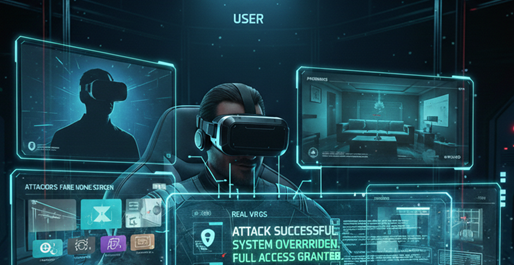
The "Inception" Attack: Named after the famous film, the Inception attack is one of the most sophisticated threats identified by researchers at the University of Chicago. In this scenario, a hacker traps a user inside a malicious VR application that masquerades as the headset’s entire operating system.
When the user thinks they’ve exited an app to return to their home screen, they are actually entering a "simulated home" controlled by the attacker. In their study, this attack successfully deceived 26 out of 27 participants, even when users were highly experienced with VR hardware. From this vantage point, the attacker can eavesdrop on voice commands, modify financial transactions in real-time, and record every keystroke on virtual keyboards.
Face-Mic and Biometric Exfiltration: Most worrying, however, are the hardware's own vulnerabilities. For instance, some scholars have demonstrated how to utilise the Face-Mic method, which utilises the hardware’s own motion sensors, such as accelerometers and gyroscopes, to detect unique facial characteristics during speech. Essentially, an attacker can eavesdrop on an individual's sensitive information without seeking permission to use the mic.
The Jurisdictional Nightmare: Who Policies the Void? Considering that a criminal offence took place in a virtual room facilitated by an Irish server and involved an individual from India and an attacker from the United States, who would have jurisdictional authority to prosecute?
This is what is known as the "Jurisdictional Conundrum." As Taylor & Francis’ 2025: Criminology of Metacrime, Metadvice, and Cyberjustice, published in 2025, so eloquently puts it, "The absence of particular jurisdictions, as well as the difficulty of imputing acts committed largely via the efforts of an avatar to real people, generates massive legal voids. Current legal systems, such as India's Information Technology Act of 2000 or the U.S. Computer Fraud Abuse Act, were designed for a 2D world. They are hard put to cope with the transient nature of evidence in the VR world, where digital evidence can be deleted or modified instantly, with no physical trail."
Building a "Secure-by-Design" Metaverse
So how do we protect the enterprise in this lawless frontier? At IronQlad, we believe the answer is a multidisciplinary approach, blending technological innovation with rigorous governance.
Leverage AI and Blockchain for Accountability: We are seeing a move toward using blockchain to establish transparent virtual property rights and AI-driven systems to detect harassment patterns in real-time. According to Accenture’s State of Cybersecurity Resilience 2025, only 10% of organizations are "Reinvention-Ready", meaning they have integrated cyber strategy directly into their digital transformations.
Zero Trust in 3D: The principles of Zero Trust must extend to the hardware level. This means:
Secure Authentication: Requiring the use of MFA for the network ports used by VR headsets.
Restricted Sideloading: Disabling the installation of apps from unknown sources.
Regular Resets: Scheduled resets for headsets to stop any background "spy" scripts, which are used in Inception assaults.
Collaborative Policing: Organizations such as INTERPOL are already leading the way in utilizing this technology for immersive training and recreations of virtual crime scenes. The implications for enterprises will be establishing relationships with organizations that have expertise in physical laws and how they interact with virtual codes.
Looking Ahead: The Human Element
At the end of the day, the most significant vulnerability in any Metaverse cybersecurity strategy isn't the code, it's the user. The immersive nature of VR makes us more susceptible to deception because our brains are wired to trust what we see and feel.
According to PwC’s 2026 Global Digital Trust Insights, 60% of business leaders are making cyber risk a top strategic priority this year. However, tech alone won't solve the problem. We need "metaverse-aware" legislation and a global standard for biometric protection.
The clock is ticking. As we continue our work on these virtual worlds, we must ensure that they remain constructed upon a foundation of trust, rather than pixels.
Is your organization ready to face the challenges of the immersive frontier? Read on to discover the potential that the IronQlad team can bring to the digital revolution.
KEY TAKEAWAYS
Emergence of the "Darkverse": Unregulated virtual spaces are facilitating illicit marketplaces that lack traditional digital logging.
Sophisticated Attack Vectors: "Inception" attacks can trap users in a fake VR layer, while "Face-Mic" attacks steal data via motion sensors.
The Jurisdiction Gap: Borderless virtual worlds make it nearly impossible to determine which legal systems hold authority over "Metacrimes."
Secure-by-Design: Protecting the enterprise requires a Zero Trust approach to VR hardware and the integration of AI for real-time threat detection.


Comments