
Security Challenges in the Tactile Internet Ultra-low-latency networks and real-time haptic communication vulnerabilities
- Swarnali Ghosh

- May 21
- 4 min read
SWARNALI GHOSH | DATE: MAY 18, 2026
Introduction
Envision a surgeon carrying out a complex heart bypass 2,000 miles away, or a specialist fixing an electrical grid using a haptic interface. The delay in either scenario is not a simple irritation; it can lead to death. This is what the future holds for us, as we enter the world of the Tactile Internet (TI), a concept brought about by 6G networks.
But here is the catch: when you reduce latency to sub-millisecond levels, you also reduce the window for security verification. According to Recommendation ITU-T Y.3149, the Tactile Internet requires a round-trip delay of 1ms or less to maintain human-perceptual synchronization. This "speed of thought" requirement creates a massive security paradox: how do you encrypt and verify data when you don't even have a millisecond to spare?
The Pillars of the Tactile Infrastructure

To achieve these impossible speeds, the architecture relies on two critical technologies that, while innovative, introduce their own set of "soft" targets.
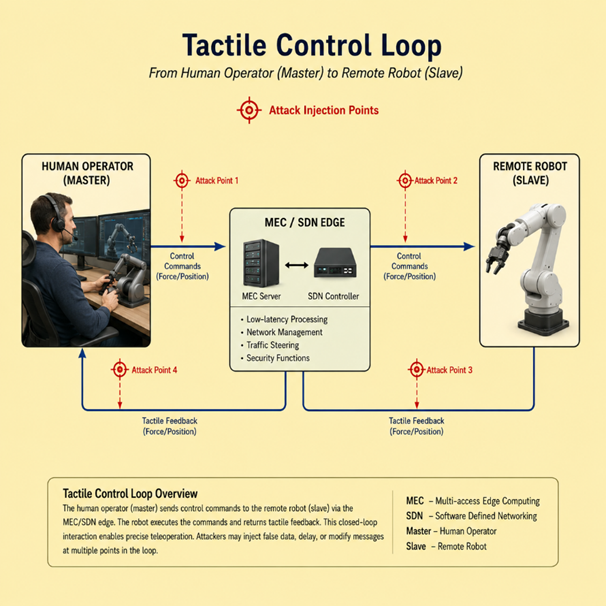
SDN and the Centralized Risk: Software-Defined Networking (SDN) is the brain of the operation, providing the programmability needed to reroute traffic instantly. However, as noted in the MDPI 2025 report on MEC and SDN technologies, this centralization makes the SDN controller a "single point of failure." If an attacker gains access to the controller, they don't just steal data; they gain the ability to manipulate the entire physical flow of a factory floor or a surgical theatre.
Edge Intelligence (EI) and MEC: Because the speed of light limits how far data can travel in 1ms (roughly 200km in fibre), we have to push processing to the very edge of the network. Mobile Edge Computing (MEC) places the "brains" closer to the user. While this solves the latency issue, it expands the attack surface exponentially. Instead of one secure data centre, you now have thousands of mini-servers at the edge, each a potential entry point for a breach.
Technical Insight: The IETF's 2026 Tactile Internet Application Requirements highlight that haptic data is multi-modal. This means a single attack could desynchronize video and touch, causing "sensorineural mismatch"-essentially making a remote operator physically ill or causing them to overcompensate with dangerous physical force.
The Three Great Vulnerabilities of Real-Time Haptics
When we move from 5G to 6G, the stakes for security grow. Here’s what my team at Iis watching most closely:
Haptic Hijacking and Data Injection: In a standard web environment, a Man-in-the-Middle (MitM) attack might steal a password. In the Tactile Internet, it can result in "haptic injection." An attacker could subtly alter the force-feedback sent to a remote operator. According to research published in PMC's 2024 6G Security Challenges, unauthorized access to the haptic stream can lead to "impersonation attacks" where a malicious actor takes over the control loop entirely.
The Cryptography Conundrum: Traditional encryption (like RSA) is computationally "heavy." It adds milliseconds of delay- the very thing the Tactile Internet cannot afford. As a result, many TI applications are tempted to use "lightweight" security. However, IEEE Xplore’s 2025 survey on URLLC security warns that conventional secret key-based techniques are being replaced by Physical Layer Security (PLS). PLS exploits the randomness of the wireless channel itself, but if the environment is static, the security can become predictable and by passable.
Cross-Slice Contamination: 6G utilizes "network slicing" to allocate a specific virtual pathway for a surgical robot, independent of someone’s Netflix video streaming service. However, network slicing does not involve physical barriers. In case of improper isolation, any breach within a less secure network slice (such as open Wi-Fi access) can possibly affect the secure tactile network slice.
Beyond the Lab: High-Stakes Applications
We aren't just talking about theory here. The integration of Digital Twins and Neuromorphic Computing, technologies that mimic the human brain’s processing, is already happening.
Remote Surgery: A packet error rate higher than $10^{-7}($one in ten million) can lead to catastrophic failure during tele-surgery. As cited in the MDPI 2025 study, these systems require "ultra-high reliability" of 99.99999%.
Industrial Automation: In "Industry 4.0" settings, autonomous robots work alongside humans. If the haptic feedback loop is delayed by even 5ms, the robot may not "feel" a human in its path until it is too late.
Securing the Future: The IronQlad Perspective
For IronQlad and throughout our network of partners, including the cybersecurity experts at AmeriSOURCE and the artificial intelligence researchers at AJA Labs, the solution is in Autonomous Integrated Architecture.
We are heading towards “Zero Trust at the Edge”. That doesn’t mean just checking a user upon login; it means verifying each and every haptic packet in real time through AI-threat detection at sub-millisecond speeds, matching the speed of the network.
The Tactile Internet is arguably mankind’s greatest technological feat. It offers to democratize expertise, enabling the technician in Tokyo to repair a piece of equipment in Toronto as if he were actually standing next to it. But without integrating security at a fundamental level with the 6G signal itself, we risk more than data compromise; we put ourselves at risk of real-world violence.
KEY TAKEAWAYS
The 1ms Threshold: Security protocols need to be executed within a sub-millisecond timeframe, rendering classical encryption ineffective for haptic communication.
Edge Threats: Shifting computations from central nodes to MEC servers decreases latency while opening up thousands of entry points for hackers.
Physical Effects: Flaws such as "haptic injection" pose a risk of causing harm in industrial environments or during remote surgery.
Guaranteed Stability: 6G technology needs to have a 99.99999% probability of success to avoid disasters in closed-loop real-time systems.


Comments