
Web Cache Poisoning: When Performance Optimization Becomes Your Greatest Security Liability
- Swarnali Ghosh

- 1 day ago
- 4 min read
SWARNALI GHOSH | DATE: APRIL 23, 2026
Introduction

In the endless race for achieving page loads below a millisecond mark, the Content Delivery Network (CDN) technology has become the key to a successful enterprise. This is one side of the story; the other and darker side that many people choose to ignore is that the same technologies used for expanding your online reach are becoming tools for undermining you.
Based on security expert Martin Doyhenard’s research, web cache poisoning has evolved from an esoteric topic into a real threat that delivers attacks against the corporate world. This means that the attacker’s objective is no longer to poison the content for a particular individual; it is now to exploit your system into providing malicious content to all visitors on your home page.
The "Semantic Gap": Where Speed Meets Vulnerability
In our experience as IronQlad cybersecurity experts, we pay particular attention to what is known as the "semantic gap." This concept goes well beyond buzzwords since it refers to the basic misunderstanding that happens between two distinct computer systems in interpreting a single HTTP request.
According to TechTarget, your caching systems rely on cache keys to recognize resources, including the request method and the URI. All other data is known as "unkeyed." And this is where the problem comes up when you use any unkeyed data to create an output in your application.
If an attacker can manipulate that unkeyed input to include a malicious script, and the cache thinks the request is "normal" based on the key, the cache saves that poisoned version. Suddenly, your CDN is enthusiastically distributing malware on your behalf.
Probing the Implementation Flaws
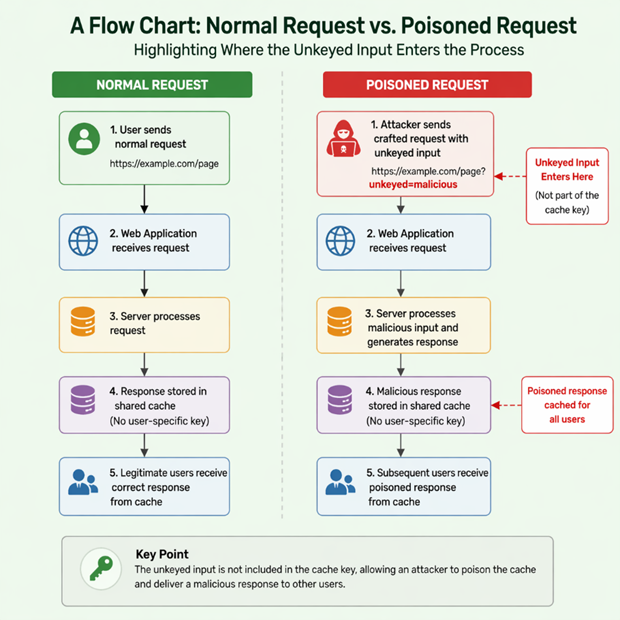
How does an attacker actually pull this off in a production environment? It’s a methodical, three-step "recon" process that often happens right under the nose of standard monitoring tools.
Identifying the Cache Oracle: The attacker looks for "tells", headers like X-Cache: hit or subtle differences in response times, to confirm if they are talking to the cache or the server.
Probing Key Handling: They experiment to see what the cache ignores. Does the system strip the port from the Host header? Does it ignore the query string?
Finding the Gadget: Once they know how to "blind" the cache, they find a "gadget", a small reflected XSS or an open redirect, to chain into the final exploit.
The Anatomy of Modern Exploits: Cloaking and Normalization
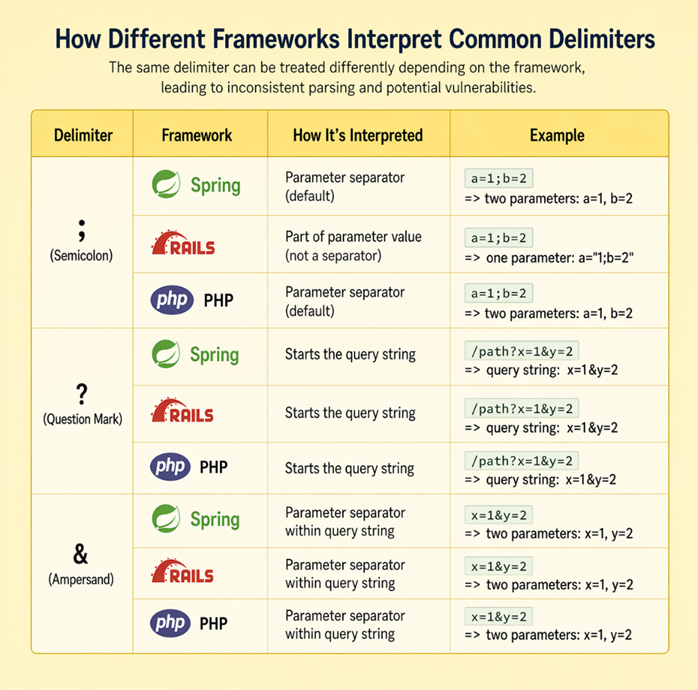
We’ve moved far beyond simple header injection. Today’s threats leverage sophisticated parser discrepancies that would make even a veteran DevOps engineer do a double-take.
Cache Parameter Cloaking: This attack vector is favoured by attackers due to its subtlety. Various caching mechanisms employ different delimiters (for example, ?, & or ;) when processing user input. Should your cache interpret the delimiter as marking the start of a parameter, but your back-end server doesn’t, then an attacker is able to mask his payload within a supposedly harmless parameter.
Normalization Quirks: URL normalization is a standard practice, but inconsistencies here are a goldmine for attackers. If a cache URL-decodes a path before generating a key, but the origin server sees the raw encoded version, an attacker can use an unencoded payload to poison the cache. When a legitimate victim visits the standard, encoded URL, the cache serves the unencoded, malicious response it has "helpfully" stored.
"Fat" GET Requests: While rare, some legacy or misconfigured systems allow "fat" GET requests GET requests that include a body. If the cache only keys the request line while the server pulls data from the body, you have a recipe for a widespread cache poisoning event that bypasses almost all traditional filters.
CPDoS: The Silent Website Killer
Beyond data theft, there is the Cache-Poisoned Denial-of-Service (CPDoS). This is particularly devastating because it’s so simple. An attacker sends a request that looks valid to the cache but triggers a 400 or 500 error at the origin server (perhaps by using an oversized header).
The cache, thinking this is a legitimate response for that URL, stores the error page. Now, every user trying to access your site receives that error. One single request can effectively paralyze your digital presence across an entire geographic region.
"One simple request can paralyze a website across a large geographical region, affecting mission-critical updates or security alerts." IronQlad Threat Intel Report
Securing the Edge: Our Defensive Framework
So, how do we stop this without sacrificing the speed your business depends on? At IronQlad, we advocate for a layered defence-in-depth strategy that bridges the semantic gap.
Strong Cache-Control: While seemingly straightforward, there are many companies that don't implement it correctly. Any dynamically produced responses should have explicit Cache-Control: no-store or private headers if not needed for any caching.
The Vary Header Power: Using the Vary header to specify the exact headers that affect the response is critical in forcing those headers to appear in the cache key and thus avoiding being blind to attackers.
WAF Implementation: In addition to the IronQlad deployment, we advise using a Web Application Firewall (WAF) in front of the cache so that suspicious headers ("X-headers") such as X-Forwarded-Host can be removed.
Normalization at the Edge: It is crucial that both the edge and origin normalise things in the exact same way. Otherwise, you open the door for a possible attack.
The Bottom Line
According to Geeksforgeeks, Web Cache Poisoning serves as an example of how in the world of enterprise information technology, there can be no such thing as an optimal solution that can simply be set in motion and forgotten about.
Are you confident that your CDN isn't currently hosting a "poisoned" gift for your next visitor?
Explore how IronQlad security suite can audit your edge configurations and harden your digital transformation journey.
KEY TAKEAWAYS
Semantic Gap Is the Real Reason: Vulnerabilities are caused by the misinterpretation of HTTP requests between the CDN and the origin server.
CPDoS Is the Increasingly Prominent Danger: Attackers can manipulate caches into caching error pages, causing a widespread, difficult-to-debug denial-of-service attack.
Default Headers Are Not Sufficient Protection: Dependence on default values of cache headers poses certain risks. It is necessary to use varied headers and a WAF filter.
Parsing Becomes Important: Misunderstandings may occur when the framework uses a different delimiter parsing than expected, such as in the case of Spring or Ruby on Rails frameworks.



Comments