
The Role of Digital Forensics in Fighting Cybercrime
- Minakshi DEBNATH

- 4 days ago
- 5 min read
Minakshi Debnath | Date: April 8, 2026
The "smoking gun" isn't what it used to be. In a world where our professional and personal lives are etched into silicon and cloud servers, the evidence of a crime is rarely a physical fingerprint it’s a sequence of timestamps, a fragmented registry key, or a subtle anomaly in an API log.

But here’s the reality: as our reliance on digital infrastructure becomes total, the complexity of protecting it has skyrocketed. Digital forensics has evolved from a niche technical task into a critical pillar of the global justice system. At AmeriSOURCE, we’ve seen firsthand how this discipline provides the clarity needed to reconstruct events, maintain legal integrity, and ultimately hold bad actors accountable.
The Strategic Shift: From Forensics to DFIR
The days of "dead analysis" simply pulling a hard drive and looking at files at rest are largely behind us. While IBM’s guide to digital forensics defines the field as the rigorous process of preserving and analyzing electronic evidence, the industry has shifted toward a more dynamic model.
We now talk about Digital Forensics and Incident Response (DFIR). According to the SANS Institute’s curriculum on DFIR, this convergence allows IT teams to accelerate threat remediation in real-time while ensuring that underlying evidence isn't trampled during the cleanup. Think of it as a specialized trauma surgeon who is also trained to preserve the crime scene while saving the patient.
The Lifecycle of a Digital Investigation
You can’t just "wing it" when it comes to evidence. If the process isn’t repeatable and reliable, it’ll be shredded in court. That’s why we lean heavily on the frameworks provided by the National Institute of Standards and Technology (NIST) and ISO standards.
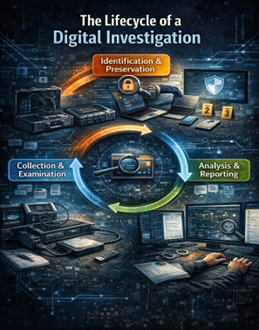
The process generally follows a strict path:
Identification & Preservation: We inventory hardware and isolate devices. But timing is everything. As noted by the University of Hawaii, volatile data in RAM is lost the moment a system shuts down. This "live analysis" is often where we find active malware or encryption keys.
Collection & Examination: Using write-blockers like the OpenText Tableau TX1, we create bit-by-bit forensic images. We then use suites like Magnet AXIOM to parse registry keys and recover deleted fragments.
Analysis & Reporting: This is where the story comes together. We reconstruct timelines and attribute actions to specific users, translating "tech-speak" into objective reports for stakeholders.
"According to research on blockchain-based evidence, decentralized ledgers could improve evidence traceability by as much as 90%, addressing the most common reason for case dismissal: poor chain-of-custody documentation."
Specialization: The New Frontiers of Evidence
As an IT leader, you know that evidence is no longer just on a laptop. It’s everywhere. This has led to highly specialized branches within the field:
Mobile and IoT Forensics
Smartphones are essentially high-powered tracking devices. Oxygen Forensics points out that the challenge in 2025 is bypassing sophisticated encryption and handling thousands of different hardware models. Meanwhile, IoT forensics extracting data from smart cameras or industrial sensors requires models like the Weighted Prioritization Model to decide which device to "interrogate" first before data is overwritten, as discussed in recent PMC research.
The Cloud Complexity
When you don't have physical access to the server, things get tricky. Cloud forensics focuses on API logs and identity management (IAM) anomalies. At AmeriSOURCE and our sister companies like bodHOST and IronQlad, we emphasize that cloud investigations are as much about legal jurisdiction and data sovereignty as they are about technical extraction.
The AI Force Multiplier (and the Deepfake Threat)
We’ve reached a point where the sheer volume of data makes manual review impossible. This is where AI steps in. According to EC-Council University, machine learning can process millions of logs instantly to find patterns that a human would miss.
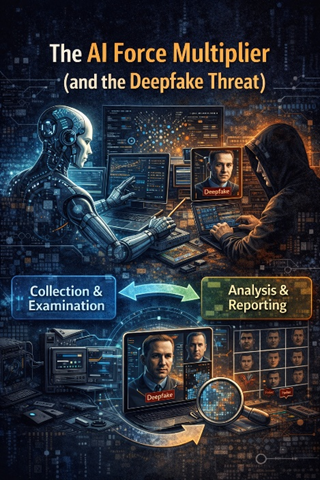
But there’s a dark side. Threat actors are using "Dark LLMs" to scale phishing and creating deepfakes for impersonation fraud. Sensity AI notes that we are now using GAN (Generative Adversarial Network) artifact analysis to find the "digital fingerprints" left by AI-generated media. We’re fighting fire with fire using AI to catch the AI.
The High Cost of Being Unprepared
The stakes couldn't be higher. Look at the 2017 Equifax breach. As ECS Infotech details, forensic teams were the ones who traced the attackers' movements through the Apache Struts vulnerability. Without that forensic trail, the financial and reputational liability would have been even more catastrophic.
White-collar crime follows a similar pattern. Whether it's embezzlement or corporate fraud, CyberCentaurs highlights how we now trace cryptocurrency flows and social media interactions to establish conspiracies that once lived only in shadows.
Navigating the Legal Minefield
In Europe, GDPR mandates strict handling protocols. In the U.S., HIPAA protects medical data even during fraud investigations. Our role at AmeriSOURCE is to ensure that your investigation remains compliant with these global standards, including the ISO/IEC 27043 principles for structured incident investigation.
Looking Ahead: Forensic Readiness
As we look toward a future of 5G and quantum computing, the "wait and see" approach to security is dead. The most resilient organizations are moving toward Forensic Readiness.
This means making your systems "forensic-grade" before an incident happens. It involves centralized, immutable logging and regular audits. By the time a breach is detected which SISA reports can take 6 to 12 months it's often too late to start building your evidence trail.
When something goes wrong a breach, an intrusion, a quiet compromise you almost didn't catch the question that follows is always the same: what actually happened? Digital forensics is how you answer it. Not with guesswork, not with assumptions, but with evidence. It's the difference between suspecting you were hacked and knowing knowing who, knowing how, and having the proof to back it up.
That clarity matters whether you're untangling the aftermath of a complex ERP implementation gone sideways or trying to lock down a cloud environment that should have been airtight. The truth buried in your systems is always recoverable. You just need the right people and the right tools to surface it.
That's where AmeriSOURCE comes in alongside specialized labs like AJA Labs and IbsynScientific bringing the kind of deep forensic expertise that doesn't just explain the past, but helps you build something stronger going forward. Because digital resilience isn't a destination you arrive at once. It's something you earn, case by case, finding by finding.
KEY TAKEAWAYS
When Forensics Meets Response: You can't separate investigation from action anymore. The best teams handle both at once, preserving legal-grade evidence while actively shutting down the threat.
The Clock Starts at Power-Off: RAM doesn't wait. The moment a machine goes dark, critical evidence disappears with it. Live memory analysis isn't optional it's the difference between a lead and a dead end.
Fighting AI with AI: Attackers are using artificial intelligence to fabricate reality deepfakes, synthetic identities, manipulated footage. Defenders are fighting back with techniques like GAN artifact analysis, because the tools of deception are evolving just as fast as the tools of detection.
Don't Wait for a Breach to Get Ready: Forensic readiness means building evidence integrity into your infrastructure before something goes wrong. The organizations that investigate well are the ones that prepared well long before the incident ever happened.

Comments